
– Ishan Maharjan
“…Party struggles lend a party strength and vitality; the greatest proof of a party’s weakness is its diffuseness and the blurring of clear demarcations; a party becomes stronger by purging itself…” (From a letter of Lassalle to Marx, of June 24, 1852; taken from What is to be Done?)
Introduction
Since the recent election, which our party [The Revolutionary Communist Party of Nepal] boycotted, we have been in a United Front with three other parties. These are: the Communist Party of Nepal (Bahumat) CPN(B), the Scientific Socialist Communist Party of Nepal (SSCPN) and the Communist Party of Nepal(CPN). This is a United Front ‘of equals’. This is a criticism of this policy by our party. Since it is also this line of reasoning which has led to other errors, such as the student wing of the party (i.e., ANNISU (Revolutionary)) working together with liberal student organizations. A right-opportunist danger lurks before us, which is why it is necessary to make clear the errors of the party.
The Maoist conception of the United Front
It is necessary to establish first of all, that Maoism does not understand the United Front in the same way as the pre-Maoist tradition does. When we speak of the United Front, we do not speak of it as “the unity of all workers willing to fight against capitalism – including those workers who still follow the anarchists, syndicalists, etc.” When the theses were adopted at the Fourth Congress of the Comintern, the idea held by the communist leadership at the time was very different to how Maoists perceive of the United Front today. When Mao spoke of the United Front as one of the three instruments of revolution, he did not speak of it in this regard.
Mao writes “unite the working class, the peasantry, the urban petty bourgeoisie and the national bourgeoisie, form a domestic united front under the leadership of the working class, and advance from this to the establishment of a state which is a people’s democratic dictatorship under the leadership of the working class and based on the alliance of workers and peasants.” Here, it must be made clear what Mao means by the United Front. He does not mean, as some today assert, that there must be a united front between the Marxists and the Revisionists. Instead, the basis of unity must be a unity of action on the basis of class struggle. Moreover, Mao asserts that this United Front must act as the basis of new power.
It is not only Mao who formulates the question this way, every major contributor to the modern Maoist tradition formulates it as such. Consider Charu Majumdar who writes:
“The party that is not engaged in directing an armed struggle has no business in talking about a united front. This is because such a party is quite unable to build a united front on the basis of an independent and clear-cut policy. Consequently, it inevitably finds itself at the tail-end of things. A united front can be successfully built up only by directing an armed struggle. The principal thing about a united front is that it is the united front of the working class and the peasantry. Only such a united front can unite the middle classes and can unite, even temporarily, with all those with whom unity is possible. Only a revolutionary party can carry out this task. And in the present era the sole criterion to judge whether a party is revolutionary or not is whether the party is directing an armed struggle or not.”
and
“Hence, the working class as the leader and the middle class as a revolutionary class must unite with the peasantry. It is precisely this unity which we call the united front. This is the only Marxist understanding of the united front.”
Indeed, it does not suffice to merely quote the greats of the past. Such an assertion must be justified. Why must we adhere to the framework of Chairman Mao, Gonzalo and Majumdar? Because their framework was revolutionary! Take for instance what comrade Charu Majumdar says. The United Front as a policy can only be entered into by a party which is engaged in an armed struggle, because it is only such a party that can preserve a clear-cut and independent communist line.
Moreover, we feel compelled to add what comrade Majumdar does not explicitly state. This worker-peasant alliance as the core nucleus and the petit bourgeois (and potentially national bourgeois) elements surrounding it, are the basis of new power. Indeed, only a party directing an armed struggle can engage in such united fronts, because it is only they who can create such new power. We cannot conceive of such a party which is engaged in such a business of united fronts outside the sphere of new power which is simultaneously revolutionary (i.e., which rejects the peaceful accumulation of forces). A united front in the Maoist sense is an alliance of the revolutionary classes and is thus the basis of new power, and any sense in which it is used outside of this is not revolutionary.
Also, regarding the Maoist formulation, it has been said that we must not oppose the United Front of today because even Chairman Mao shook hands with Chiang Kai-Shek when the Chinese nation was in danger. Therefore, the Revolutionary Communists of Nepal must shake hands with the comprador bourgeois elements, and treat the petit bourgeois elements as equals! The Communist Party of China (CPC), working with the Kuomintang (KMT), was because of the immediate threat to the Chinese nation, this is partially true. When Japan invaded China the local comprador bourgeoisie of China was either brought into the Japanese fold, acting directly on behalf of Japanese finance-capital, or, it was “demoted” so to speak to the level of the national bourgeoisie.
When the CPC worked with the KMT in the Anti-Japanese United Front, it was because the national struggle of resistance against Japan, and the class struggle of the Chinese people against Japanese finance capital had become identical at that stage in the class struggle. The comprador bourgeoisie had either succumbed entirely and become integrated wholly into the Japanese economy, or they found common interest with the proletariat of China. Today, in Nepal, there is no identity between the class struggle and the national struggle. Do we find that the comprador bourgeoisie has been de-classed en masse? We do not.
Moreover, it must be noted that the CPC at this stage were engaged in armed struggle! The Agrarian war in the countryside had been raging for years. This we do not find in the party today. Which is why we assert that the current policy of the united front is incorrect.
Now, regarding the other parties of the United Front, it is important to ascertain why they are revisionist, and why a front of equals with them is, in principle, unacceptable.
The semi-Marxism of the parties of the United Front
The criticism of the program of the parties of the United Front shall be limited to a criticism of the program of the CPN(B) and the SSCPN. We shall not at this time criticize the CPN, since they are a small party and their party documents have not been made available at this moment. Therefore, it is not possible to fairly criticize this party, any criticism of them would come from a place of ignorance; ignorant criticism is unacceptable among Marxists. However, the programs of the CPN(B) and the SSCPN have been available somewhat publicly and thus, a criticism of them is possible and necessary.
1. The CPN(B)
Let us first take the CPN(B). They advocate for a socialist revolution. Now, it is unclear on what basis they are arguing such a thing. Nepal is not free of comprador capital. The very minimum consensus of this United Front is on the basis that Nepal is dominated by comprador capital. The CPN(B) cannot but agree that Nepal is dominated by comprador capitalism. The Marxist formulation for the elimination of the comprador economy, the establishment of a new state power and the creation of a technico-political base which can begin socialist construction is the NDR and not the socialist revolution.
The two lines in the Nepali Communist movement, the revolutionary line and the line of the phrasemongers are demarcated precisely on this basis. The NDR is the sole path which Nepal can take. Nepal today does not have the technical and political basis for socialist revolution and socialist construction. As per the National Sample Census of Agriculture 2021/2022’s Report on Land use, we see that agriculture has become more scattered and dispersed with time. Reading “Despite 8 percent increase in the number of holdings, there has been a 12 percent decrease in the total area of holdings during the last two censuses. The area under holdings increased by only 32 percent over the sixty-year period though the number of holdings increased by 168 percent during the same period. The recent trend of the last two censuses shows a discrepancy as the number of holdings increased by 8 percent, but the total area of holdings decreased by 12 percent.” No one will forget however that the socialization of agriculture presupposes a degree of concentration of agricultural land, it is then not possible to jump from Nepal’s current situation to a social revolution.
It seems that the members of the CPN(B) have been entranced by the theory of permanent revolution. Do they consider it possible to sidestep the peasants and introduce socialism in one stroke? Do they consider it possible to be able to skip the democratic stage of the revolution? Such a thing is not possible, not today. As long as there exists a comprador economy, it needs to be smashed. No one will forget what this semi-Bolshevik, semi-Menshevik theory is. It is petit bourgeois utopianism, a theory which considers it possible to ignore the necessity of the democratic revolution. Their theory which is more Trotskyist than it is Bolshevik reeks of the same petit bourgeois deviation which was condemned at the 13th Congress of the Russian Communist Party. To reject the NDR is to reject Marxism and join the side of Trotskyism.
They simultaneously are compelled to admit the dominance in Nepal’s national economy of comprador capital, while at the same time rejecting the necessity of the NDR. Nepal is a neocolonial state, where there is the firmest unity between the local comprador bourgeoisie and the international financiers. Nepal does possess finance capital; Nepal’s banking and industrial capital are tied into a firm knot. However, this finance capital is qualitatively different from, say, American or Chinese finance capital. Whereas in the usurer states it is possible to at once socialize the means of production, the same is not possible in Nepal.
This is since, the capital present in Nepal is not based on the domestic development of the relations of production. The import of capital and commodities (capital being a special type of commodity) is the fundamental basis of Nepal’s economy. Nepal did not develop capitalism on its own basis, through the dynamics of its own feudal contradictions, but such a capitalist development was imposed by the imperialist powers. The way this is done is through the fusion of embryonic national capital with finance capital to form comprador capital. This comprador capital further hinders the full development of the productive forces and relations of production here.
This comprador capital is a form of finance capital, of this there is no doubt. But since it is not a social relation which developed on the basis of Nepali society but on the basis of foreign imposition, this is not a technical base on which socialism can be established. Hence, once again, the task of the Nepali communists and of all revolutionary classes in Nepali society is and remains New Democracy.
In accepting the premise yet refusing the natural conclusion, these subpar Marxists show themselves so completely confused, that they have rejected Marxism, in favor of Trotskyism. This is their fatal flaw. And let us not forget what Trotskyism really is. It is the ideology of the petit bourgeoisie in the labor movement.
2. The SSCPN
They too consider a social and not a NDR to be necessary for Nepal. Thus, all the criticisms we had hitherto levied against the CPN(B) are equally if not more applicable to the SSCPN. To this however are added other distortions which makes them perhaps even more revisionist than the CPN(B) (Surprising, I’m aware!). They base their justification of their ‘theory’ on the basis of the so-called emergence of ‘new productive forces’. Let us now see what they mean by this. More grotesque however, is their use of this to justify the Kautskyian theory of ultra-imperialism by disguising it under the cloak of “globalized capitalism i.e., imperialism”.
What exactly is this “globalized capitalism, i.e., imperialism”? It is, according to them, an era proceeding imperialism where due to the rising importance of science and technology, these become the primary productive forces thus displacing capital. Resulting in this transformation in the base, a change in the politics of this epoch occurs. Monopoly capital, through multinational companies, have reached a level that they can unite in oppressing and exploiting the colonies and semi-colonies. This should be tackled from the root. Whence arises this new era in global capitalism? They say, from the rise of science and technology as the new productive forces. By science, we assume that they mean the natural sciences.
The issue with the notion of science and technology displacing capital as the primary force of production is that science and technology are themselves forms assumed by capital. Capital is not merely machines, tools etc. used to produce but a relation. Capital is in relation within itself and with human labor power. In relation with itself, it assumes various forms to interact with itself in its process of reproduction and accumulation; in its relationship with labor power, it transforms it into capital and compels it to exist in servitude to it. Science, a product of the human mind, an aspect of the creative energy of human labor power, is transformed into capital when placed in the domain of production. Technology is merely an advancement in capital, not a replacement of capital itself. The power loom was “technology” compared to the hand loom. This changed the relation of capital to labor, forcing the latter into a more subservient position, however, it did not itself constitute something “not capital”. Both science and technology are themselves capital and, thus, cannot displace it. The only way to displace capital is to abolish it and to abolish all relations (value relations) that flow from it. Therefore, there is no “new era of imperialism.”
Moreover, from the point of view of practical revolutionary activity, it is clear they do not seek to engage in revolutionary activities. It is well known that they are advocates of ‘dual economy’ i.e., building up a ‘socialist’ economy which exists alongside the capitalist economy and will eventually engulf it. They thus seek to build up these new productive forces, by… engaging in commodity production! They assert that a ‘socialist economy’ can be built by operating under the logic of bourgeois right within a bourgeois framework. They represent not the interests of the proletariat who desire to see commodities and capital-relations demolished once and for all but the petit bourgeoisie who seek to build up their sphere of influence within the dictatorship of capital.
The Vulgar Front of today
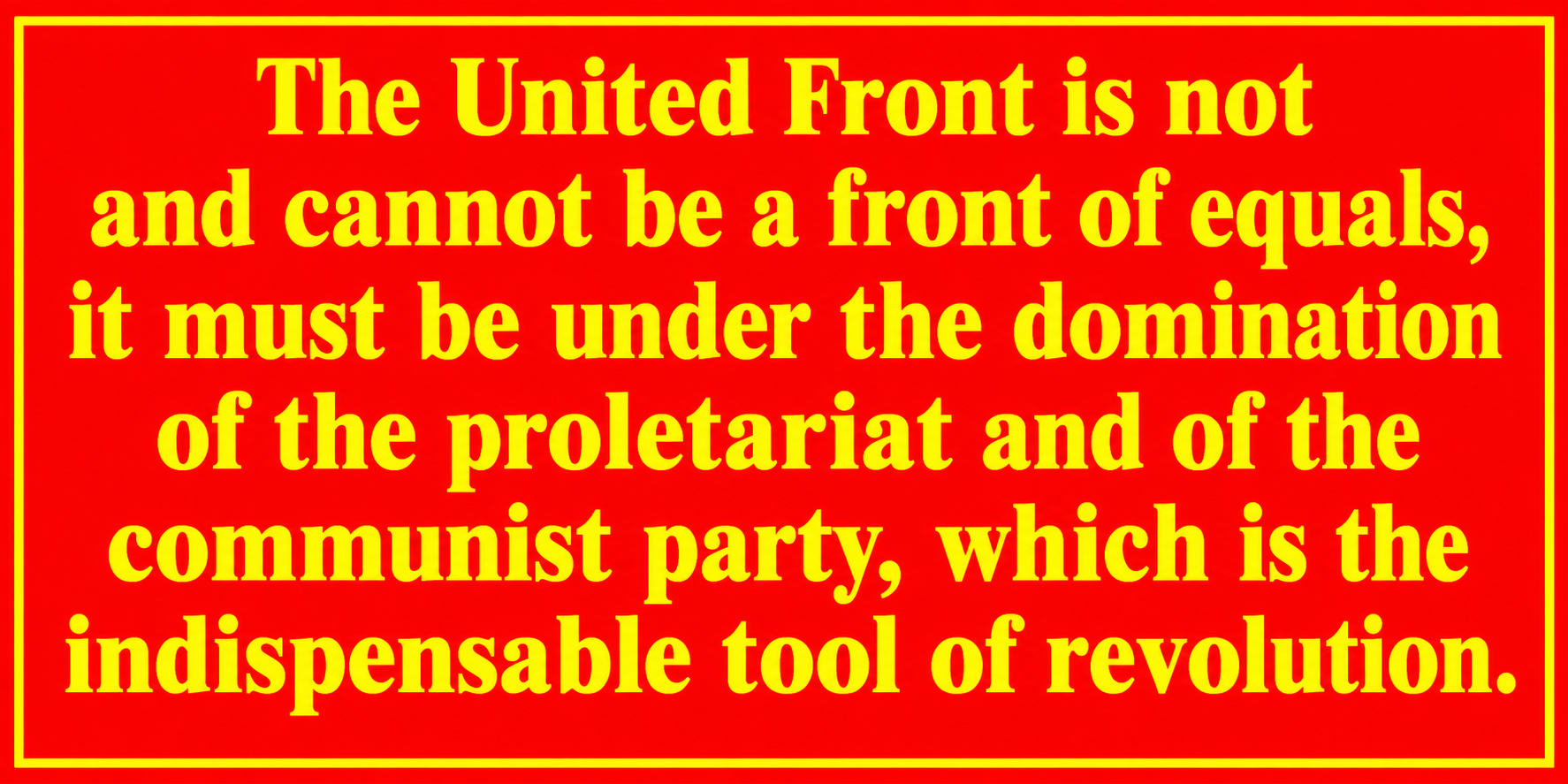
The United Front of today is a United Front ‘of equals’ where the petit bourgeois elements are given an equal say to the proletarian element i.e., to the Revolutionary Communist Party of Nepal (RCPN). The way in which this United Front ‘of equals’ is operating is quite contrary to the workings of a revolutionary United Front. New Democracy is the democratic revolution led by the proletariat as a class-for-itself, i.e., by the communist party. The revolutionary aims of our movement cannot be fulfilled if we form such alliances with forces that are not for our revolution. The proletariat in the New Democratic struggle cannot subject itself or consider itself an equal force to the petit bourgeois elements within the United Front. Such a United Front, would be, to quote comrade Gonzalo ‘a bastardization’ of what the United Front really is. The United Front is not and cannot be a front of equals, it must be under the domination of the proletariat and of the communist party, which is the indispensable tool of revolution.
It is only possible to form such fronts under the condition of armed struggle, or at the very least under conditions which allow us to demarcate strictly an independent proletarian line. However, we do not have an independent proletariat line, we have the greatest possible muddle and diffuseness within the Front, and within the party. As long as this is the case, there can be no consideration of a Front.
To carry out our revolutionary tasks, to carry out the program of the New Democratic revolution, the party cannot make such alliances of equal standing with the petit bourgeois parties. Either, the United Front would have to subject the petit bourgeois parties to the communist party, or, would have to go another way. Such a United Front, wherein the petit bourgeoisie is considered of equal importance to the New Democratic tasks is completely unacceptable and contrary to the revolutionary essence of the United Front. Since, fascism is not a disease but a symptom. To cure the disease itself requires the New Democratic revolution. To fulfill the New Democratic program requires that any concession, any alliance be under proletarian leadership and, therefore, in the final analysis under the leadership of our party.
Ideological Decay in the Nepali Communist Movement
Consider the Article by the ex-Marxist Prachanda titled “People’s War and the Problem of Development of the United Front”, this entire article, despite being written by a renegade, is quite illuminating on the question of the United Front.
The framework on the United Front which is used by Prachanda in this article is the same one which we have laid out above. It is fully congruent with Chairman Mao, with comrade Charu Majumdar and with the great thinkers of Maoism.
No one will forget the betrayal of Prachanda and his clique, their liquidation of our revolution and their surrender to the bourgeois camp. However, we assert that Prachanda on this question was more correct than our party leadership is today. Yet, it is this Prachanda, who fell so far, in spite of approaching this question from a more correct point of view. It is this Prachanda who liquidated the revolution despite leading the revolution with an ideological standpoint, which is on the whole more correct. Our leadership today, for all their struggles, sacrifices, all their correct aspects, are starting from a lower starting point, compared even to that renegade Prachanda! If we were to engage in revolutionary activity today, if we were to struggle for our liberation today, we are significantly more likely to crash and burn precisely because we are starting even lower — ideologically — than Prachanda.
The party leadership thinks it necessary to revitalize our organizational and political activity. Indeed, this is necessary, there is no doubt. But, organization alone, without a proper ideological orientation, without a correct ideological orientation will lead us not to revolution but to the swamp. We cannot possibly conceive of the revitalization of the organization of the party, of the political reconstitution of the party, without first clarifying important ideological questions.
The prime task of the communists of today, when the proletariat is in retreat, is not to jubilate about our limited activity, but to reckon with the sobering reality of the situation. This sobriety is precisely what is lacking in our party. We build our political and organizational muscles to engage in revolutionary activity. But, why we do so and how, must first of all be clear.
Today, not only in Nepal, but also internationally, there exists the greatest possible diffuseness of ideas, the greatest possible blurring of demarcations. For the sake of an illusory unity, first in the form of party unity, then in the form of the United Front, we have sacrificed ideological clarity, we have sacrificed a great part of the revolutionary line. Today, except for the Great People’s Wars of India and the Philippines, all the other People’s Wars have been either crushed or have liquidated their struggle. The World Proletarian Revolution is in retreat. It is in such a time that we can have but one, all-important task, which we cannot shirk… The Ideological and Political Reconstitution of the ICM!
