
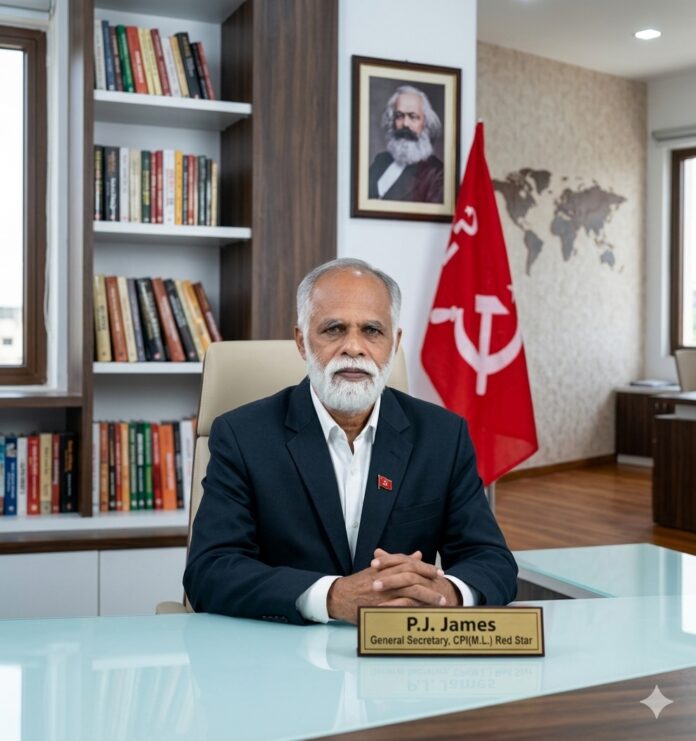
– P.J. James
General Secretary of CPI (ML) Red Star
1. It is a matter of great happiness that the 13th Party Congress of the CPI (ML) Red Star was successfully held in Raichur, Karnataka, from 16 to 20 September 2026. Congratulations on being re-elected as the General Secretary. How do you feel on this occasion?
Ans: As per the Constitution of CPI (ML) Red Star, General Secretary of the Party is chosen by the Central Committee which is elected by the Delegates to the Congress. Policy decisions are taken by the Central Committee, and the task of the General Secretary is to take initiative for implementing them in proper coordination with the Polit Bureau which is also elected by the Central Committee. And the General Secretary also acts as the chief spokesperson of the Party. Regarding the question on my feeling now, suffice it to say that the dictum ‘personal is political’ is applicable to the person who is elected as the office-bearer a political party
2. The situation in the world is changing rapidly. There is speculation about the possibility of a Third World War. The political situation in India has also undergone considerable changes. The communist movement is facing a setback. In such a situation, what plans were formulated at the Raichur Congress to advance and strengthen the communist movement in India?
Ans: Of course, as per the Leninist perception, war is implicit in imperialism, even as the dialectic of collusion and competition remains as inherent driver of inter-imperialist contradictions. However, in the postwar neocolonial phase of imperialism, even though inter-imperialist contradictions have been sharpening, the leading imperialist powers, especially the descending imperialist hegemon US and the ascending imperialist power China today, are reluctant to settle their contradictions through a world war as it will be suicidal for them. As such, both the Anglo-Saxon Western imperialist bloc and the China-Russia led Eastern imperialist bloc, are settling their contradictions and ensuring their plunder through regional/local and proxy wars. The latest Sino-US deal at White House with the view that Trump’s “MAGA” agenda and Xi’s goal of “national rejuvenation” mutually reinforce and coexist, and the declaration to avoid a “Thucydides trap” – a dangerous pressure toward war when a rising power threatens to displace an already established power – amply proves that the leading imperialist powers are keen to avoid a Third World War. Regarding the Indian situation, CPI (ML) Red Star is of the firm position that under the Modi government which is ideologically led by RSS, the largest and longest-running fascist organisation in the world, India has been transformed into a fascist regime. While remaining as a lackey and junior partner of US imperialism, India is expansionist in its approach towards neighbouring countries such as Nepal, Bangladesh and Sri Lanka. True, the Communist Movement is facing many ideological-political and organisational setbacks at a global level and in India. The Communists are failing to put forward a political alternative to fascism and imperialism in the post-Cold War 21st century neoliberal period. In this general background, though the Indian Communist movement has a glorious history of sacrifices, we have to self-critically admit that it failed to apply Marxism-Leninism according to the concrete conditions of India. The most crucial issue in this regard is the mechanical and Eurocentric class analysis pursued by the Communist movement that ignored the role of Indian caste system as the solid basis of the social formation/mode of production in India in particular and South Asia in general. To put it differently, Indian Communism and its self-professed Marxist theoreticians who identified Caste as part of the cultural superstructure, failed to analyse how Caste is decisive in division of labour, wage structure, surplus value extraction, ownership of the means of production, wealth appropriation and social, economic cultural and political power. In the same vein, the Eurocentric understanding on imperialism and fascism in gross disregard of the ‘law of impermanence’ that every social phenomenon is constantly changing according to space and time, also did immense damage to building up the anti-fascist and anti-imperialist united front in 21st century, especially in the context of the internationalisation capital. Similarly, the communists also failed to appropriately analyse the contradiction between capital and nature, or how capital is destroying nature, the fundamental source of human existence like that of labour. All these and other core issues are appropriately taken up in the Program and Basic Documents of the CPI (ML) Red Star adopted by the 13th Party Congress. In brief, based on the theoretical-ideological, political and organisational perspectives as adopted by the Congress, the Party is moving forward with the immediate task of overthrowing RSS fascism and the long-term task of changing the system, both of which are integral and inseparable.
3. There is widespread opposition among the people in India to the fascist policies of the RSS-BJP. In Nepal too, the ruling Rastriya Swatantra Party is implementing what are described as fascist policies. What, in your view, are the fundamental roots of fascism in these two countries?
Ans: The material basis of fascism everywhere is the most corrupt and reactionary corporate capital merging itself with the fascist political leadership or the regime. Unlike classical fascism of the interwar period, under internationalisation of capital in the neoliberal period and in the 21st century “fourth industrial revolution”, fascism can emerge in any country including even neocolonial dependent and oppressed countries. However, the ideological basis of fascism may vary according to the concrete historical, social and cultural specificities of countries – for instance, Christian Evangelism in the Americas, racism, ethno-nationalism and neo-atheism in Europe, Zionism in Israel, Hindutva or political Hinduism in India and Nepal, Buddhism in Myanmar and Sri Lanka, and even political Islam in West Asia. Thus, instead of pursuing a copy-paste/text-copy method, the task of building up the broadest possible front for overthrowing fascism in each country should be based on a concrete analysis of fascism in each country. Of course, while taking up the immediate task of building up such an anti-fascist movement in which even non-fascist ruling classes may be involved, the Left and Progressive-Democratic forces should be cautious enough not to surrender the long-term and strategic class interests of the working class and oppressed in the guise of anti-fascist unity.
4. US imperialism has created immense devastation in the name of war in the Middle East. US imperialism is also exploiting and oppressing the people of South Asian countries, including India and Nepal, in various ways. Is it possible to bring the anti-imperialist forces of the South Asian countries onto a common platform?
Ans: US imperialism continues as the number one enemy of world people. In the Gaza genocide and holocausts upon holocausts unleashed on Palestinians by the Zionist regime, the ‘military outpost’ US in the Middle East, US is the acknowledged co-perpetrator of the war crimes. And, including the latest aggression on Iran, the US-Zionist axis of evil with Islamophobia or anti-Muslimness as the ideological basis, is systematically violating all International Laws and UN Conventions. In the same manner, US imperialism is engaged in sinister form of loot and plunder of Latin America, Africa and Asia-Pacific. In South Asia, the US has been using India, the junior partner as a launching pad in its machinations against China which is also now contending with US for global hegemony. It is this context that, four parties, viz., FLSP of Sri Lanka, CPI (ML) Red Star from India, SPB from Bangladesh and RCPN from Nepal met in Kolkata in July 2024 and formed the South Asian Initiative to carry forward the anti-imperialist and antifascist tasks. However, except a few Online meetings, much work in this direction has not taken place. Renewed initiatives with more ideological-political clarity are needed to strengthen the fraternal cooperation and coordination among South Asian parties against imperialism and fascism.
5. Your party has been taking initiatives for several years towards the Caste Annihilation Movement (CAM). How much progress has been made in this direction?
Ans: Without annihilating the inhuman caste system that identifies the Dalits and Women as subhuman, there can be no democracy. That’s why CPI (ML) Red Star upholds annihilation of caste as one of the strategic tasks of People’s Democratic Revolution (PDR) in India. It is with this perspective that the Caste Annihilation Movement (CAM) was formed immediately after the 9th Party Congress in 2011. However, much work in this direction through strengthening CAM at the pan-Indian level is needed yet, especially when along with Islamophobia or anti-Muslimness, Casteism is also functioning as the ideological basis of RSS fascism.
6. In Nepal, the participation of the younger generation in the communist movement is reportedly very weak. What is the trend among young people towards joining the communist movement in your country?
Ans: Not only in Nepal, even India and elsewhere, the youth is disgusted with traditional and institutionalised parties including Communist parties. Viewed from a standard left perspective, the so-called techno-savvy “Digital Natives” of the 21st century who are also called Gen Z (followed by Alpha), appear to be non-ideological and apolitical too. At the same time, the recent Gen Z movement across many countries based on specific issues, such as unemployment, corruption, price-rise, etc., have even led to regime changes in countries like Nepal. And, the failure on the Communists and Progressive-Democratic forces to have proper communication with such movements in the language of the youth and consequent appropriate intervention in them, have resulted in the hijacking of them by far-right neoliberal forces too. In this regard Nepal is a typical example. The volent Gen Z uprising there last year, leading to the ascendance of the far-right Rastriya Swatantra Party is not an overnight development. As per reports, starting from the apparently indigenous “Hami Nepal” movement, the volent youth uprising in Nepal were trained, financed and digitally coordinated by a whole set of American agencies such as International Republican Institute, National Endowment for Democracy, USAID, Freedom House, Open Society Foundation, etc. In India, such confirmed reports are not there. However, being the most populous country and due to the continental size and diversities, a regime change operation solely led by Gen Z seems to be difficult in India. At the same time, vigilance and intervention from the broad spectrum of anti-fascist sections have facilitated the Gen Z movement in India to take on an anti-fascist direction also. The Communist Movement, based on a self-introspection has to appropriately intervene in the emerging youth movement.
7. Many communist parties around the world regard Marxism-Leninism-Maoism as their guiding ideology. Your party continues to uphold Mao Thought as a guiding ideology. What, in your view, are the problems with accepting Maoism as a guiding ideology?
Ans: True, CPI (ML) Red Star does not accept Maoism as a distinct, separate stage of revolutionary theory, preferring instead to uphold Marxism-Leninism-Mao Zedong Thought. As per our understanding, the Chinese Communist Party never used the term “Maoism” even when parties outside China codified it. For us, ‘Stalinism’ and ‘Maoism’ are aberrations/deviations though used in different contexts. The CPI (ML) Red Star limits itself to adoption of “Mao Zedong Thought,” viewing it as the application of Marxism-Leninism to the specific historical conditions of China, and also rejects any ‘Chinese path’ for India. Maoism in our perception is an adventurist, dogmatic, sectarian and anarchist deviation, which obstructs mass mobilizations, building anti-fascist democratic fronts, and engaging in political processes to confront neoliberal corporatism and far-right fascism. Though Communist Party of India (Maoist), Communist Party of Nepal (Maoist Centre), Communist Party of the Philippines, the Colombian Communist Party – Maoist, Revolutionary Communist Party, USA (RCP), Communist Party of Peru (Shining Path) and others adopted Maoism, ideologically we oppose such formulations from a Marxist-Leninist perspective.
8. In order to eliminate the CPI (Maoist), or, as it is described, to make India “Naxalism-free,” the Modi government conducted “Operation Kagar.” During Operation Kagar, many Maoist cadres, including the General Secretary of the Maoist Party, were killed. In your opinion, what weaknesses prevented the Maoist organisation from ensuring the security of its rank and file?
Ans: As already stated, our Party has fundamental ideological differences with “Maoists”. At the same time, time and again, we have been resolute in opposing and condemning the unleashing of state terror on Maoists and the most inhuman manner in which the fascist Indian regime was suppressing the Maoists. While the intensified and targeted state repression was the immediate cause behind the failure of Maoists, its fundamental reason lay deep in their ideological-political and organisational line which are not in conformity with the concrete Indian reality in the postwar neocolonial-neoliberal phase of imperialism. Maoist analysis of India as semi-colonial and semi-feudal and invoking of the ‘Chinese path’ for India’s liberation, were not in conformity with the vast changes that had already taken place consequent on India’s integration with global capital under its internationalisation. As such, due to a host of factors including their analysis of the tribal question and caste issue including the evaluation of caste as part of Indian feudalism (even as caste is safely seated on the throne of modern industry, science and technology and is even migrating to Silicon Valley), they were alienated from the caste-oppressed and most downtrodden people even in the Red Corridor called Dandakaranya, the forest heartland of India. Consequently, as the fascist regime penetrated into their core base, the Maoists began to shrink from their hold over nearly 180 districts during the first decade of the 21st century to 38 districts in 2024. While the Modi government intensified its military operations following the ascendance of the fascist ‘double engine’ government in Chhattisgarh along with the offer of unconditional surrender, the Maoists faced an erosion of its core tribal base, partly due to the tactical moves in this regard by the regime. For, as per reports, though 99% of the fighters in Dandakaranya were tribals, and half of them being women, not a single tribal person or woman had ever held a seat in the Central Committee. The party’s leadership remained overwhelmingly non-tribal and Telugu-speaking. Though Hidma one of the seniormost commanders was inducted into the Central Committee, it was too late. And, as per the deadline announced by the Indian regime, by 31 March 2026, the official proclamation of ending Maoist insurgency also has come out.
9. Some political parties in Nepal describe Indian expansionism as Indian imperialism. What is your view on this?
Ans: We are also of the opinion that the RSS led fascist regime in India, is acting as a “big brother” in South Asia. This big brotherly, expansionist approach of the fascist Indian regime in tune with the ‘Akhand Bharat’ (Undivided India) concept of a greater, unified, South Asia in consonance with the “cultural nationalism” of RSS is envisaged under the safe shield provided by the imperialist master, the US. Obviously, the Indian regime which clings on to the apron strings of US, due to its class character, is not yet qualified to be characterised as imperialist, rather it acts as a junior partner of US imperialism, according to our analysis. With world’s largest chunk of “absolute” or “extreme” poor and ranked 149th globally by per capita income, India is often called the “citadel of global poverty”. Of course, under internationalisation of capital, corporate billionaires from India like Adani, Ambani, Tata, etc., can enter into the hierarchy of global corporate capital as junior partners of imperialist MNCs. However, in the realm of technologies, especially regarding 21st century frontier technologies including Digitisation and Artificial Intelligence, India is abjectly depending on imperialist countries. For instance, in the case of Digitisation, for the entire software India depends on US and on China for hardware. And, crucial policy decisions concerning India are dictated by neoliberal centres and IMF-World Bank-WTO trio, even as parliament is remaining as a show case. Of course, this issue needs detailed discussion.
10. India is a monopoly capitalist country. For capitalist countries, socialist revolution is generally considered the appropriate path. However, your Party Congress has adopted a proposal to advance the line of People’s Democratic Revolution (PDR). How does this differ from the path of New Democratic Revolution (NDR)?
Ans: From a Leninist perspective, monopoly capitalism means imperialism. As such, India is not a monopoly capitalist country or a capitalist-imperialist country where the stage of revolution is socialist. As per our Party Program, India is in the stage of People’s Democratic Revolution (also called New Democratic Revolution). The principal contradiction, according to the Party Program, is “the contradiction between the alliance of imperialist-corporate-bureaucratic-bourgeois-landlord classes on the one hand and the broad masses of people on the other.” People’s Democratic Revolution is the formulation of Comintern, while New Democratic Revolution is the term used by Mao in the case of China, and in essence, both are the same.
11. What advice would you like to give to the communist parties in Nepal for advancing the communist movement there?
Ans: In our view, the revolutionary task in each country should be fulfilled by Communists and their alliance partners of that country. In this regard, our comradely suggestion to Nepal Communists as fraternal comrades, is to take up the task of revolutionary transformation of Nepal based on a concrete analysis of the Nepali society in the background of the neoliberal-neofascist international situation today.
12. Is there anything else you would like to convey to our readers through the Hank weekly magazine?
Ans: CPI (ML) Red Star extends its revolutionary Greetings to the Hank Weekly. Let’s continue our comradely relation and work together in our fight for the liberation of the working class and all oppressed peoples from exploitation and oppression. 000
Comments
- Advertisement -