
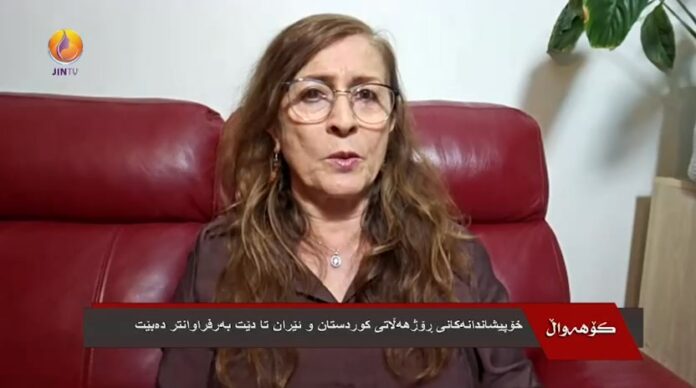
Halaleh Taheri
Dec 5, 2025
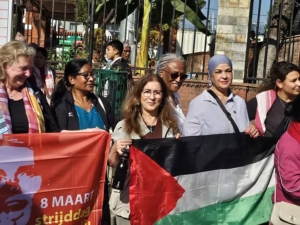
On the 25th of November, I participated in a protest in Kathmandu, Nepal, where I gave a speech about the situation of the women’s movement in Iran, particularly the situation of political prisoners. I urged the attendees to support the struggle of Iranian women and, in particular, to demand the freedom of female political prisoners as an act of solidarity—especially in opposition to the execution sentences issued against Vrisheh Moradi, Pakhshan Azizi, and Sharifeh Mohammadi, who are currently facing capital punishment by the Islamic Republic.
After the protest, we held a four-day conference in Kathmandu, the capital of Nepal, attended by 350 people. It was organized by an organization called Courage from Germany, together with the support from women’s section of the Communist Party of Nepal.Also, ICOR is a network of socialist women’s organizations affiliated with socialist parties that work together as a coalition. Their representatives came from many different countries, such as Peru, Cameron, South Africa, various European countries, Turkey, India, and others. I was one of the speakers at this conference, addressing the situation of women in Iran under the rule of the Islamic Republic and its theocratic system. I also spoke about the 2022 uprising, how Mahsa Amini was killed by the regime, and how women rose up, burned their hijabs, dismantled gender apartheid, and took to the streets. I updated the representatives on the current situation and ongoing repression, explaining that more than 1,000 people have been executed, with many more on death-row lists. Despite this, the women’s movement continues its struggle and, in practice, many women refuse to obey the regime’s rules on hijab and gender segregation. Today the balance of power in the streets is almost equal between the morality police and pro-hijab forces on one side, and young women and men who continue to celebrate and practice their freedom on the other. The reception to my speech was extremely positive, and attendees expressed strong solidarity. Afterward, many wanted to learn more about the situation of women in political prisons and the direction of the women’s struggle in Iran. They also asked whether the recent Israeli attacks had affected the situation of women in Iran, what happens inside prisons under the Islamic Republic, why the government executes so many people, and whether Iranians truly want to overthrow the regime. These questions were raised with great enthusiasm, and we continued talking long after the formal sessions ended. The conference had representatives from more than 20 countries, and over three consecutive days various panels were held with women activists from political parties—especially socialist parties—labour unions, independent women’s organizations and women’s rights defenders. The event was translated into eight different languages, and the role of women from African labour unions was particularly notable.
On the first day, the focus was especially on socialist parties and socialist women, along with representatives from labour unions and women from Cameroon, South Africa, Congo, Sri Lanka, India, and Nepal. Many of the socialist women were from Europe, and I participated as a representative of the Iranian Socialist Party. The main task of that day was to create a roadmap for socialist women’s organizations. We focused on how to reintroduce socialism—long attacked and misrepresented—to the people and to women, and how to connect it with other social movements, including youth movements, justice movements, anti-corruption campaigns, refugee rights groups, and antiwar networks. The central question was how to unite these movements. We stressed the importance of alliances, because our aims reflect their hopes and demands.
Many proposals were made during the conference, including the need for a unified platform. This platform criticized capitalism, nationalism, and the rise of fascism. We also declared that all nationalist movements and theocratic governments are forms of oppression that must be opposed. Feminism was also discussed: while we welcomed cooperation with feminist groups, we emphasized the need for clarity. Under capitalism, feminism has often become limited and integrated into narrow frameworks, whereas our program seeks to address the root causes of women’s oppression and to build a new system. By the end, several resolutions were adopted, and I requested that the conference include support for political prisoners in Iran and opposition to execution, especially the death sentences of women political prisoners.
We also witnessed great potential among the younger participants. They spoke about injustice, corruption, exploitation, and the extreme inequality between workers and billionaires. Many older socialist women noted that today’s youth tend to engage in dynamic, campaign-based activism, rather than long-term organizational structures. Their understanding of socialism is shaped by a different era, and our role is to help guide them toward a deeper understanding. By combining their energy with our experience, we can attract a powerful global force into the socialist movement.
Dec 5, 2025
