
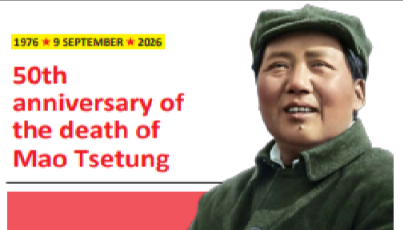
(The matter is taken out from HOY, a WEEKLY NEWSPAPER OF THE
REVOLUTIONARY COMMUNIST PARTY OF ARGENTINA,YEAR 42 / No. 2124 / BUENOS AIRES, ARGENTINA, 2 ,SEPTEMBER 2026 )
Mao argues that the revolution in dependent or semicolonial countries such as China must resolve democratic tasks that historically had resolved by the bourgeoisie – such as agrarian reform – but that in the 20th century these tasks can no longer be spearheaded by the bourgeoisie. That is why he argues that this is a democratic revolution of a new type, a new democracy or a people’s democracy, which must be led by the proletariat.
In Argentina, a dependent country, there are also tasks to be undertaken in the areas of democratic, agrarian and anti-imperialist revolution. But that revolution can only avoid going from defeat to defeat if it is led, through its ideas and leadership, by the proletariat, on the basis of an alliance with the peasantry and within a broad front withthe other classes or sectors interested in the revolution; the hegemony of the workingclass, led by its party, will enable the uninterrupted transition to socialism. The difference in the revolutionary path in Argentina isthat, in China, due to the weight of the peasantry, The revolution moves from the countryside to the city, confronting the enemy’s forces with armed struggle from the very outset. In Argentina, the working class is not only theleading force but also the main force of the revolution; the urban population carries decisive weight, as our history shows, from the Cordobazo, the Tucumanazo, the Correntinazo, the Rosariano and other historic popular uprisings such as the Argentinazo and 17 October. Students, intellectuals, the petty bourgeoisie and the patriotic and democratic sectors of the national bourgeoisie are also part of the revolutionary united front. That is why we define as our strategy the insurrectionary path, rational path, which will undoubtedly be linked to peasant uprisings in which the peasants, together with indigenous peoples and nations, play a decisive role. We have not set out to repeat what Lenin proposed or to copy what Mao said, but ratherto integrate their teachings into the reality of Argentina, guided by Marxist theory and taking into account our history at each specific political juncture. This is set out in our party’s programme: what kind of revolution and why. That is why, in Argentina, the revolutionary path does not lead from the countryside to the city via a revolutionary people’s war, but is insurrectionary; although there are also regions where, as we see today in the Chaco, the main contingents taking up the struggle are peasants and indigenous peoples, due to the very structure of our country. And it is
necessary to find the paths leading to the revolution at every political juncture. This issue of the different paths of revolutionary war in each country was a fundamental contribution by Mao Tsetung, and he made it amidst controversy and struggle within the leadership of the Chinese Communist Party and with the Communist International led by Stalin.
THE LONG MARCH
The Long March was one of the most significant military feats in history. The forces
led by Mao and Zhu De, the army commander, set out from the Jiangxi Soviet following the
failure of the Autumn Harvest Uprising in 1927 at the hands of the Kuomintang. They were
forced to flee into the nearby mountains, heading west and then north, against the backdrop of the Japanese invasion. The aim was to reach Yan’an,where the Shanxi Soviet was based. For a year, from 1934, they covered 12,500kilometres – bear in mind, to understand what this means, that the distance from Ushuaia to La Quiaca is some 3,720 kilometres – travelling on foot, accompanied by the occasional mule or pack horse crossing eighteen mountain ranges—the highest in the world—and twenty-four major rivers, including the Yangtze and the Yellow River, whilst constantly fighting. Throughout China,
word spreads of the Red Army’s conduct: handing over land to the peasants and confronting the landlords; paying for the food they need and treating prisoners well. This is the communists’ great propaganda. During the Long March, in 1935, Mao was elected General Secretary of the CPC.
It was very interesting for us, for whom the Cuban Revolution was always a constant presence, to discover that the revolutionary struggle that began in the Sierra Maestra, led by Fidel Castro and Che, had followed a very similar path to that of China.
YAN’AN AND THE RESISTANCE AGAINST JAPAN
From Yan’an, in the face of the Japanese invasion, Mao put forward the need to reestablish a United Front with the Kuomintang – the very same people who had killed 100,000
communists, including Mao’s wife and two children. It is clear that at that moment there was a common enemy: Japan. The Front entailed unity and struggle, with independence within it, whilst directing the main blow against the invader. Chiang Kai-shek opposed the principle at first, until his own generals forced him to accept it. It was a political front, with two armies facing the same enemy whilst maintaining their independence.
In Yan’an in 1935, Mao wrote his two main philosophical works, ‘On Contradiction’ and ‘On Practice’, in 1935, convinced that without incorporating dialectics and changing one’s method of thought, no progress can be made.
The People’s Army, led by the Chinese Communist Party, was the main force that defeated the Japanese, and when Chiang Kaishek turned against the Communists in 1944, with the support of the Americans, Mao continued the struggle. And he did not accept the agreement reached by the victors of the Second World War at Yalta – which proposed dividing China into two parts, as they had done in Korea and Vietnam. The People’s Army crossed the Yangtze and enteered Beijing in triumph.
THE TRIUMPH OF THE 1949 REVOLUTION
On 1 October 1949, the revolution triumphed, following fifteen years of a people’s war that
defeated the Japanese invasion and the Kuomintang, and the People’s Republic of China was proclaimed. Chiang Kai-shek, supported by the Americans, took refuge in Taiwan. With the revolution triumphant, the central measures were democratic, popular and antiimperialist: land reform, the expropriation ofimperialist monopolies, the Marriage Law, and major advances in health, education and living and working conditions. All democratic parties were allowed to continue. and popular. Between 1949 and 1978, the year of the capitalist restoration, life expectancy rose from 38 to 68 years, the population grew from 540 to 900 million, and illiteracy was virtually eradicated, with 98 per cent having completed primary school and millions ofworkers and peasants attending secondary school and university.
THE STRUGGLE TO ADVANCE TOWARDS SOCIALISM
Mao sets out the need for the revolution to advance towards socialism; to this end, he states that the three major divisions of class society must be resolved: between man and women, between intellectual and manual labour, and between the countryside and the city. The commune will be the foundation for tackling this task and consolidating popular power; within it, not only economic unity but also political, military and productive unity will be realised, with the masses playing a leading role in deciding what is produced, how it is produced, and how the produce is distributed.State-owned enterprises will be organised in the same way. In the popular commune, which was fundamentally agrarian, industries were established to bridge the gap between peasants and workers. As in the commune of Tachai, which we visited and which we took as a model to follow, situated in an inhospitable and mountainous area, where they managed to cultivate terraced fields
—just as the Incas did in the Americas— ca- transporting the earth in hand-carried litters; a tractor factory was built there.■
